

 659 お客様のコメント
質問 1:
You trained a text classification model. You have the following SignatureDefs:
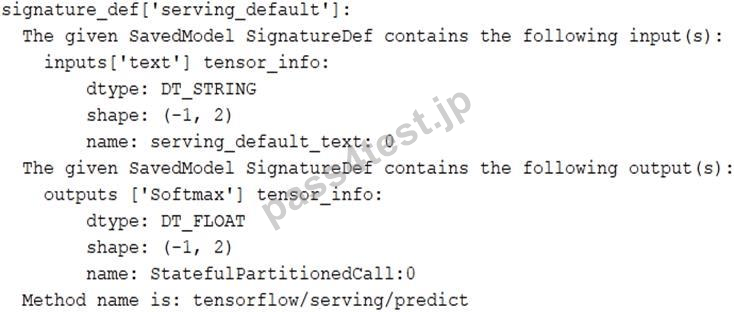
You started a TensorFlow-serving component server and tried to send an HTTP request to get a prediction using:
headers = {"content-type": "application/json"}
json_response = requests.post('http:
//localhost:8501/v1/models/text_model:predict', data=data,
headers=headers)
What is the correct way to write the predict request?
A. data = json.dumps({"signature_name": "serving_default", "instances" [[`a', `b'], [`c', `d'], [`e', `f']]})
B. data = json.dumps({"signature_name": "seving_default", "instances" [[`ab', `bc', `cd']]})
C. data = json.dumps({"signature_name": "serving_default", "instances" [[`a', `b', `c'], [`d', `e', `f']]})
D. data = json.dumps({"signature_name": "serving_default", "instances" [[`a', `b', `c', `d', `e', `f']]})
正解:A
解説: (Pass4Test メンバーにのみ表示されます)
質問 2:
You have deployed a deep learning model to an Agent Platform endpoint using a machine type with NVIDIA GPUs. You initially configured the endpoint to autoscale based on a target CPU utilization of 60%. During a load test, you observe that prediction latency increases significantly as traffic rises, but the number of replicas remains constant. Cloud Monitoring indicates that CPU utilization stays below 40%, while the GPU utilization consistently exceeds 90%. You need to ensure that the endpoint scales efficiently to handle the increased load. What should you do?
A. Update the autoscaling configuration to scale based on the GPU duty cycle metric.
B. Increase the minimum replica count for the endpoint to match the peak load that was observed during testing.
C. Update the autoscaling configuration to decrease the target CPU utilization to 20%.
D. Redeploy the model to a machine type that includes a TPU.
正解:A
解説: (Pass4Test メンバーにのみ表示されます)
質問 3:
You work for an international bank. Your team is developing a generative AI application that summarizes complex financial reports. You need to implement an automated, scalable solution to evaluate and quantify the quality of generated summaries against the previous version of the solution. What should you do?
A. Deploy both versions of the solution, and use A/B testing to route a portion of production traffic to the new version and route the remaining traffic to the previous version. Compare user click- through rates.
B. Run an automatic side-by-side (AutoSxS) evaluation job in Agent Platform to compare outputs from the new and previous versions of the solution.
C. Run an evaluation job in Agent Platform, and calculate a BLEU score to compare the new and previous versions of the solution.
D. Use Model Monitoring to track the prediction drift of the token output length.
正解:B
解説: (Pass4Test メンバーにのみ表示されます)
質問 4:
You are an ML engineer at a bank. You have developed a binary classification model using AutoML Tables to predict whether a customer will make loan payments on time. The output is used to approve or reject loan requests. One customer's loan request has been rejected by your model, and the bank's risks department is asking you to provide the reasons that contributed to the model's decision. What should you do?
A. Use the correlation with target values in the data summary page.
B. Use local feature importance from the predictions.
C. Vary features independently to identify the threshold per feature that changes the classification.
D. Use the feature importance percentages in the model evaluation page.
正解:B
解説: (Pass4Test メンバーにのみ表示されます)
質問 5:
You work for a large bank that serves customers through an application hosted in Google Cloud that is running in the US and Singapore. You have developed a PyTorch model to classify transactions as potentially fraudulent or not. The model is a three-layer perceptron that uses both numerical and categorical features as input, and hashing happens within the model.
You deployed the model to the us-central1 region on nl-highcpu-16 machines, and predictions are served in real time. The model's current median response latency is 40 ms. You want to reduce latency, especially in Singapore, where some customers are experiencing the longest delays.
What should you do?
A. Create another Vertex AI endpoint in the asia-southeast1 region, and allow the application to choose the appropriate endpoint.
B. Attach an NVIDIA T4 GPU to the machines being used for online inference.
C. Deploy the model to Vertex AI private endpoints in the us-central1 and asia-southeast1 regions, and allow the application to choose the appropriate endpoint.
D. Change the machines being used for online inference to nl-highcpu-32.
正解:A
解説: (Pass4Test メンバーにのみ表示されます)
質問 6:
You need to design an architecture that serves asynchronous predictions to determine whether a particular mission-critical machine part will fail. Your system collects data from multiple sensors from the machine. You want to build a model that will predict a failure in the next N minutes, given the average of each sensor's data from the past 12 hours. How should you design the architecture?
A. 1. HTTP requests are sent by the sensors to your ML model, which is deployed as a microservice and exposes a REST API for prediction
2. Your application queries a Vertex AI endpoint where you deployed your model.
3. Responses are received by the caller application as soon as the model produces the prediction.
B. 1. Events are sent by the sensors to Pub/Sub, consumed in real time, and processed by a Dataflow stream processing pipeline.
2. The pipeline invokes the model for prediction and sends the predictions to another Pub/Sub topic.
3. Pub/Sub messages containing predictions are then consumed by a downstream system for monitoring.
C. 1. Export your data to Cloud Storage using Dataflow.
2. Submit a Vertex AI batch prediction job that uses your trained model in Cloud Storage to perform scoring on the preprocessed data.
3. Export the batch prediction job outputs from Cloud Storage and import them into Cloud SQL.
D. 1. Export the data to Cloud Storage using the BigQuery command-line tool
2. Submit a Vertex AI batch prediction job that uses your trained model in Cloud Storage to perform scoring on the preprocessed data.
3. Export the batch prediction job outputs from Cloud Storage and import them into BigQuery.
正解:B
解説: (Pass4Test メンバーにのみ表示されます)
You trained a text classification model. You have the following SignatureDefs:
You started a TensorFlow-serving component server and tried to send an HTTP request to get a prediction using:
headers = {"content-type": "application/json"}
json_response = requests.post('http:
//localhost:8501/v1/models/text_model:predict', data=data,
headers=headers)
What is the correct way to write the predict request?
A. data = json.dumps({"signature_name": "serving_default", "instances" [[`a', `b'], [`c', `d'], [`e', `f']]})
B. data = json.dumps({"signature_name": "seving_default", "instances" [[`ab', `bc', `cd']]})
C. data = json.dumps({"signature_name": "serving_default", "instances" [[`a', `b', `c'], [`d', `e', `f']]})
D. data = json.dumps({"signature_name": "serving_default", "instances" [[`a', `b', `c', `d', `e', `f']]})
正解:A
解説: (Pass4Test メンバーにのみ表示されます)
質問 2:
You have deployed a deep learning model to an Agent Platform endpoint using a machine type with NVIDIA GPUs. You initially configured the endpoint to autoscale based on a target CPU utilization of 60%. During a load test, you observe that prediction latency increases significantly as traffic rises, but the number of replicas remains constant. Cloud Monitoring indicates that CPU utilization stays below 40%, while the GPU utilization consistently exceeds 90%. You need to ensure that the endpoint scales efficiently to handle the increased load. What should you do?
A. Update the autoscaling configuration to scale based on the GPU duty cycle metric.
B. Increase the minimum replica count for the endpoint to match the peak load that was observed during testing.
C. Update the autoscaling configuration to decrease the target CPU utilization to 20%.
D. Redeploy the model to a machine type that includes a TPU.
正解:A
解説: (Pass4Test メンバーにのみ表示されます)
質問 3:
You work for an international bank. Your team is developing a generative AI application that summarizes complex financial reports. You need to implement an automated, scalable solution to evaluate and quantify the quality of generated summaries against the previous version of the solution. What should you do?
A. Deploy both versions of the solution, and use A/B testing to route a portion of production traffic to the new version and route the remaining traffic to the previous version. Compare user click- through rates.
B. Run an automatic side-by-side (AutoSxS) evaluation job in Agent Platform to compare outputs from the new and previous versions of the solution.
C. Run an evaluation job in Agent Platform, and calculate a BLEU score to compare the new and previous versions of the solution.
D. Use Model Monitoring to track the prediction drift of the token output length.
正解:B
解説: (Pass4Test メンバーにのみ表示されます)
質問 4:
You are an ML engineer at a bank. You have developed a binary classification model using AutoML Tables to predict whether a customer will make loan payments on time. The output is used to approve or reject loan requests. One customer's loan request has been rejected by your model, and the bank's risks department is asking you to provide the reasons that contributed to the model's decision. What should you do?
A. Use the correlation with target values in the data summary page.
B. Use local feature importance from the predictions.
C. Vary features independently to identify the threshold per feature that changes the classification.
D. Use the feature importance percentages in the model evaluation page.
正解:B
解説: (Pass4Test メンバーにのみ表示されます)
質問 5:
You work for a large bank that serves customers through an application hosted in Google Cloud that is running in the US and Singapore. You have developed a PyTorch model to classify transactions as potentially fraudulent or not. The model is a three-layer perceptron that uses both numerical and categorical features as input, and hashing happens within the model.
You deployed the model to the us-central1 region on nl-highcpu-16 machines, and predictions are served in real time. The model's current median response latency is 40 ms. You want to reduce latency, especially in Singapore, where some customers are experiencing the longest delays.
What should you do?
A. Create another Vertex AI endpoint in the asia-southeast1 region, and allow the application to choose the appropriate endpoint.
B. Attach an NVIDIA T4 GPU to the machines being used for online inference.
C. Deploy the model to Vertex AI private endpoints in the us-central1 and asia-southeast1 regions, and allow the application to choose the appropriate endpoint.
D. Change the machines being used for online inference to nl-highcpu-32.
正解:A
解説: (Pass4Test メンバーにのみ表示されます)
質問 6:
You need to design an architecture that serves asynchronous predictions to determine whether a particular mission-critical machine part will fail. Your system collects data from multiple sensors from the machine. You want to build a model that will predict a failure in the next N minutes, given the average of each sensor's data from the past 12 hours. How should you design the architecture?
A. 1. HTTP requests are sent by the sensors to your ML model, which is deployed as a microservice and exposes a REST API for prediction
2. Your application queries a Vertex AI endpoint where you deployed your model.
3. Responses are received by the caller application as soon as the model produces the prediction.
B. 1. Events are sent by the sensors to Pub/Sub, consumed in real time, and processed by a Dataflow stream processing pipeline.
2. The pipeline invokes the model for prediction and sends the predictions to another Pub/Sub topic.
3. Pub/Sub messages containing predictions are then consumed by a downstream system for monitoring.
C. 1. Export your data to Cloud Storage using Dataflow.
2. Submit a Vertex AI batch prediction job that uses your trained model in Cloud Storage to perform scoring on the preprocessed data.
3. Export the batch prediction job outputs from Cloud Storage and import them into Cloud SQL.
D. 1. Export the data to Cloud Storage using the BigQuery command-line tool
2. Submit a Vertex AI batch prediction job that uses your trained model in Cloud Storage to perform scoring on the preprocessed data.
3. Export the batch prediction job outputs from Cloud Storage and import them into BigQuery.
正解:B
解説: (Pass4Test メンバーにのみ表示されます)





饭村** -
Professional-Machine-Learning-Engineerにわかりやすくまとめた本はなかった気がします。
Pass4Testおすすめです。