
 1004 お客様のコメント
質問 1:
Cloud Service Consumer A accesses Cloud Service A (1) that resides in Cloud X. a private cloud owned by the same organization acting as Cloud Consumer A. Cloud Service A processes the message from Cloud Service Consumer A and then sends back a response with the requested data (2). Next, Cloud Service Consumer A sends a message containing some of this data to Cloud Service B (3), which resides in public Cloud Y that is owned by Cloud Provider Y. After processing the message, Cloud Service B sends back a response with additional data to Cloud Service Consumer A (4). Finally, Cloud Service Consumer A writes the data it collected from Cloud Services A and B to Database A (5).
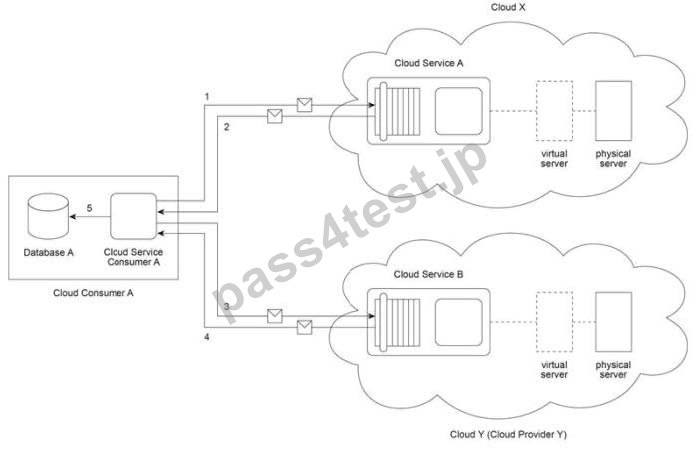
Recently, Cloud Service Consumer A has been required to access Cloud Services A and B at a significantly higher rate, sometimes over 1,000 times within a given workday. This increased usage has not affected Cloud Service B's performance. Cloud Service A, however, has been generating runtime exceptions and responses to Cloud Service Consumer A have become increasingly slow and unreliable. It is determined that this decline in performance is due to infrastructure limitations within private Cloud X's environment. Instead of investing in new infrastructure for Cloud X, it is decided to explore the feasibility of moving Cloud Service A to Cloud Y instead.
Which of the following statements describe valid financial considerations that can be taken into account for assessing the feasibility of this move?
A. Public Cloud Y charges for the use of its IT resources. Moving Cloud Service A to Cloud Y can therefore result in new on-going costs. Although Cloud Service A may be able to share some of the existing IT resources used by Cloud Service B, it will likely incur new on-going costs that need to be budgeted for.
B. Moving Cloud Service A to Cloud Y will require that Database A also be moved to Cloud Y due to the need for Cloud Service A and Database A to share a common virtual server within the same organizational boundary, as required by the cloud-based security group. The move of Database A will increase the integration testing effort and. as a result, will also increase the overall integration costs.
C. Once Cloud Service A is deployed in Cloud Y, it may form dependencies upon proprietary parts of Cloud Y that may limit its mobility should it be decided to move it outside of Cloud Y in the future. This can incur further locked-in costs that need to be accounted for.
D. By moving Cloud Service A to Cloud Y, the SaaS delivery model will be established for Cloud Service A, thereby allowing the service implementation to build upon existing infrastructure from underlying PaaS and laaS delivery models that would have been required for Cloud Service B to be implemented in Cloud Y.
正解:A,C
質問 2:
Cloud Provider X has deployed a virtualization environment in Cloud X comprised of Physical Server A hosting Virtual Servers A and B. Cloud Provider X implements Cloud Service A on Virtual Server A and makes it available to Cloud Service Consumer A, which interacts with Cloud Service A by sending and receiving messages (1, 2).
Cloud Provider Y has deployed a virtualization environment comprised of Physical Server B hosting Virtual Servers C and D. Virtual Server C is made available to Cloud Service Consumer B, which interacts with Virtual Server C (3,4) in order to prepare for the deployment of a new cloud service that will be used internally by Cloud Provider Y to process data obtained from Cloud Service A Cloud Consumer Z and Cloud Provider X belong to the same organization. Cloud Provider Y is a third-party organization. Which of the following statements provides a valid scenario that accurately describes the involvement of cloud deployment models, cloud delivery models, roles and/or boundaries? (Note that the correct answer represents one of multiple valid scenarios that can exist.)

A. Cloud X is based on the private cloud deployment model. Cloud Service A is based on the SaaS delivery model. Cloud Y is based on the public cloud deployment model. Virtual Server C is being offered as part of theIaaS delivery model. A cloud resource administrator working for Cloud Consumer Z uses Cloud Service Consumer B to access Virtual Server Cloud Consumer Z is the cloud service owner of Cloud Service A. Cloud Consumer Z's organizational boundary encompasses Cloud Service Consumers A and B. Cloud Consumer T s trust boundary encompasses Cloud Service Consumers A and B, Cloud Service A and Virtual Server
B. Cloud X is based on the private cloud deployment model. Cloud Service A is based on the SaaS delivery model. Cloud Y is based on the public cloud deployment model. Virtual Server C is being offered as part of theIaaS delivery model. A cloud resource administrator working for Cloud Consumer Z uses Cloud Service Consumer B to access Virtual Server C. Cloud Consumer Z' s trust boundary encompasses Cloud Service Consumers A and B, Cloud Service A and Virtual Server C. The organization that owns Cloud Consumer Z is the cloud service owner of Cloud Service A.
C. Cloud X is based on the private cloud deployment model. Cloud Service A is based on theSaaS delivery model. Cloud Y isbased on the community cloud deployment model. VirtualServer C is being offered as part of theIaaS delivery model. A cloud resource administrator working for Cloud Consumer Z uses Cloud Service Consumer A to access Cloud Service A. Cloud Consumer T s organizational and trust boundaries encompass Cloud Service Consumers A and B, Cloud Service A and Virtual Server C.
D. Cloud X is based on the private cloud deployment model. Cloud Service A is based on the SaaS delivery model. Cloud Y is based on the private cloud deployment model. Virtual Server C is being offered as part of theIaaS delivery model. A cloud resource administrator working for Cloud Consumer Z uses Cloud Service Consumer B to access Virtual Server C. Cloud Consumer Z is the cloud service owner of Cloud Service Cloud Consumer T s organizational boundary encompasses Cloud Service Consumers A and B. Cloud Consumer T s trust boundary encompasses Cloud Service Consumers A and B, Cloud Service A and Virtual Server C.
正解:B
質問 3:
Cloud Provider Y owns Cloud Y, which provides a set of cloud services, virtual servers, and one physical server. Cloud Services A and B are hosted on Virtual Server A, which is hosted by Physical Server A. Physical Server A also hosts Virtual Server B, which hosts redundant implementations of Cloud Services A and B for load balancing purposes. Cloud Service Consumer A is accessing Cloud Service A located on Virtual Server A. Cloud Service Consumer B is accessing Cloud Service B located on Virtual Server B. Cloud Service Consumers A and B are both owned by Cloud Consumer X.
Cloud Consumer X has recently complained that Cloud Service A is becoming increasingly unreliable. Cloud Provider Y launches an investigation that reveals that Virtual Server A has been crashing sporadically due to successful malicious intermediary attacks where malicious service agents have been inserting harmful data into messages sent by Cloud Service Consumer A to Cloud Service A.

Which of the following statements describes a solution that can mitigate the malicious intermediary attacks that have been occurring on Virtual Server A - and - can further help prevent the same types of attacks from occurring on Virtual Server B?
A. Cloud Provider Y can implement the failover system mechanism by requiring that redundant copies of all service agents be deployed. This will reduce the chances of any one service agent performing malicious actions at runtime.
B. Cloud Provider Y can implement the encryption and digital signatures mechanisms to protect the contents of messages from being augmented by malicious service agents.
C. Cloud Provider Y can implement the identity and access management mechanism for Virtual Servers A and B by physically deploying this mechanism on Physical Server A and then further implementing the resource replication mechanism to propagate the identity and access management system across Virtual Servers A and B.
D. Cloud Provider Y can implement the cloud-based security group mechanism that establishes a logical trust boundary that encompasses Virtual Servers A and B.
正解:B
Cloud Service Consumer A accesses Cloud Service A (1) that resides in Cloud X. a private cloud owned by the same organization acting as Cloud Consumer A. Cloud Service A processes the message from Cloud Service Consumer A and then sends back a response with the requested data (2). Next, Cloud Service Consumer A sends a message containing some of this data to Cloud Service B (3), which resides in public Cloud Y that is owned by Cloud Provider Y. After processing the message, Cloud Service B sends back a response with additional data to Cloud Service Consumer A (4). Finally, Cloud Service Consumer A writes the data it collected from Cloud Services A and B to Database A (5).
Recently, Cloud Service Consumer A has been required to access Cloud Services A and B at a significantly higher rate, sometimes over 1,000 times within a given workday. This increased usage has not affected Cloud Service B's performance. Cloud Service A, however, has been generating runtime exceptions and responses to Cloud Service Consumer A have become increasingly slow and unreliable. It is determined that this decline in performance is due to infrastructure limitations within private Cloud X's environment. Instead of investing in new infrastructure for Cloud X, it is decided to explore the feasibility of moving Cloud Service A to Cloud Y instead.
Which of the following statements describe valid financial considerations that can be taken into account for assessing the feasibility of this move?
A. Public Cloud Y charges for the use of its IT resources. Moving Cloud Service A to Cloud Y can therefore result in new on-going costs. Although Cloud Service A may be able to share some of the existing IT resources used by Cloud Service B, it will likely incur new on-going costs that need to be budgeted for.
B. Moving Cloud Service A to Cloud Y will require that Database A also be moved to Cloud Y due to the need for Cloud Service A and Database A to share a common virtual server within the same organizational boundary, as required by the cloud-based security group. The move of Database A will increase the integration testing effort and. as a result, will also increase the overall integration costs.
C. Once Cloud Service A is deployed in Cloud Y, it may form dependencies upon proprietary parts of Cloud Y that may limit its mobility should it be decided to move it outside of Cloud Y in the future. This can incur further locked-in costs that need to be accounted for.
D. By moving Cloud Service A to Cloud Y, the SaaS delivery model will be established for Cloud Service A, thereby allowing the service implementation to build upon existing infrastructure from underlying PaaS and laaS delivery models that would have been required for Cloud Service B to be implemented in Cloud Y.
正解:A,C
質問 2:
Cloud Provider X has deployed a virtualization environment in Cloud X comprised of Physical Server A hosting Virtual Servers A and B. Cloud Provider X implements Cloud Service A on Virtual Server A and makes it available to Cloud Service Consumer A, which interacts with Cloud Service A by sending and receiving messages (1, 2).
Cloud Provider Y has deployed a virtualization environment comprised of Physical Server B hosting Virtual Servers C and D. Virtual Server C is made available to Cloud Service Consumer B, which interacts with Virtual Server C (3,4) in order to prepare for the deployment of a new cloud service that will be used internally by Cloud Provider Y to process data obtained from Cloud Service A Cloud Consumer Z and Cloud Provider X belong to the same organization. Cloud Provider Y is a third-party organization. Which of the following statements provides a valid scenario that accurately describes the involvement of cloud deployment models, cloud delivery models, roles and/or boundaries? (Note that the correct answer represents one of multiple valid scenarios that can exist.)
A. Cloud X is based on the private cloud deployment model. Cloud Service A is based on the SaaS delivery model. Cloud Y is based on the public cloud deployment model. Virtual Server C is being offered as part of theIaaS delivery model. A cloud resource administrator working for Cloud Consumer Z uses Cloud Service Consumer B to access Virtual Server Cloud Consumer Z is the cloud service owner of Cloud Service A. Cloud Consumer Z's organizational boundary encompasses Cloud Service Consumers A and B. Cloud Consumer T s trust boundary encompasses Cloud Service Consumers A and B, Cloud Service A and Virtual Server
B. Cloud X is based on the private cloud deployment model. Cloud Service A is based on the SaaS delivery model. Cloud Y is based on the public cloud deployment model. Virtual Server C is being offered as part of theIaaS delivery model. A cloud resource administrator working for Cloud Consumer Z uses Cloud Service Consumer B to access Virtual Server C. Cloud Consumer Z' s trust boundary encompasses Cloud Service Consumers A and B, Cloud Service A and Virtual Server C. The organization that owns Cloud Consumer Z is the cloud service owner of Cloud Service A.
C. Cloud X is based on the private cloud deployment model. Cloud Service A is based on theSaaS delivery model. Cloud Y isbased on the community cloud deployment model. VirtualServer C is being offered as part of theIaaS delivery model. A cloud resource administrator working for Cloud Consumer Z uses Cloud Service Consumer A to access Cloud Service A. Cloud Consumer T s organizational and trust boundaries encompass Cloud Service Consumers A and B, Cloud Service A and Virtual Server C.
D. Cloud X is based on the private cloud deployment model. Cloud Service A is based on the SaaS delivery model. Cloud Y is based on the private cloud deployment model. Virtual Server C is being offered as part of theIaaS delivery model. A cloud resource administrator working for Cloud Consumer Z uses Cloud Service Consumer B to access Virtual Server C. Cloud Consumer Z is the cloud service owner of Cloud Service Cloud Consumer T s organizational boundary encompasses Cloud Service Consumers A and B. Cloud Consumer T s trust boundary encompasses Cloud Service Consumers A and B, Cloud Service A and Virtual Server C.
正解:B
質問 3:
Cloud Provider Y owns Cloud Y, which provides a set of cloud services, virtual servers, and one physical server. Cloud Services A and B are hosted on Virtual Server A, which is hosted by Physical Server A. Physical Server A also hosts Virtual Server B, which hosts redundant implementations of Cloud Services A and B for load balancing purposes. Cloud Service Consumer A is accessing Cloud Service A located on Virtual Server A. Cloud Service Consumer B is accessing Cloud Service B located on Virtual Server B. Cloud Service Consumers A and B are both owned by Cloud Consumer X.
Cloud Consumer X has recently complained that Cloud Service A is becoming increasingly unreliable. Cloud Provider Y launches an investigation that reveals that Virtual Server A has been crashing sporadically due to successful malicious intermediary attacks where malicious service agents have been inserting harmful data into messages sent by Cloud Service Consumer A to Cloud Service A.
Which of the following statements describes a solution that can mitigate the malicious intermediary attacks that have been occurring on Virtual Server A - and - can further help prevent the same types of attacks from occurring on Virtual Server B?
A. Cloud Provider Y can implement the failover system mechanism by requiring that redundant copies of all service agents be deployed. This will reduce the chances of any one service agent performing malicious actions at runtime.
B. Cloud Provider Y can implement the encryption and digital signatures mechanisms to protect the contents of messages from being augmented by malicious service agents.
C. Cloud Provider Y can implement the identity and access management mechanism for Virtual Servers A and B by physically deploying this mechanism on Physical Server A and then further implementing the resource replication mechanism to propagate the identity and access management system across Virtual Servers A and B.
D. Cloud Provider Y can implement the cloud-based security group mechanism that establishes a logical trust boundary that encompasses Virtual Servers A and B.
正解:B






麻生** -
Pass4Testの問題集は他の本より安い上にしっかり知識を身に着けられるから安心